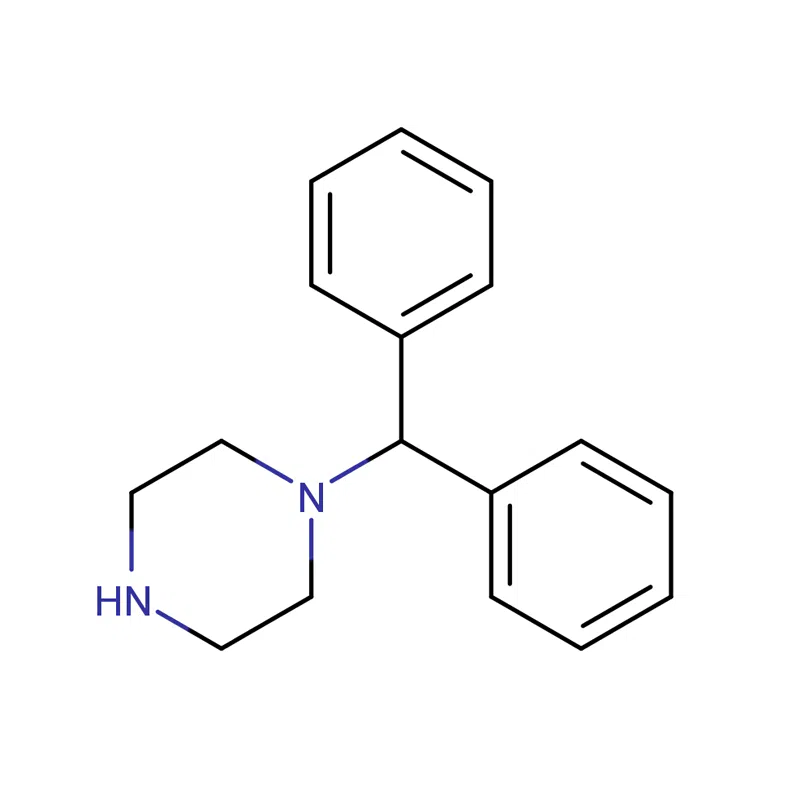
Product Description of 1-Benzhydrylpiperazine CAS#841-77-0
1-Benzhydrylpiperazine, also named N-(diphenylmethyl)piperazine, is a piperazine-based derivative with the molecular formula C₁₇H₂₀N₂. and molecular weight of 252.35. It appears as white to light yellow crystalline powder with a melting point of 90–93°C. This piperazine-based heterocyclic amine is slightly soluble in water and readily soluble in common organic solvents including ethanol, toluene and chloroform.
The molecule contains a free secondary amine group, showing high reactivity for amination and condensation reactions.It is widely utilized as an important nitrogen-containing heterocyclic intermediate for organic synthesis and pharmaceutical research.

1-Benzhydrylpiperazine Chemical Properties
| Melting point | 90-93 °C |
| Boiling point | 185°C/2mmHg(lit.) |
| density | 1.0546 (rough estimate) |
| vapor pressure | 0.001Pa at 20℃ |
| refractive index | 1.5794 (estimate) |
| Fp | 115 °C |
| storage temp. | Keep in dark place,Sealed in dry,Room Temperature |
| solubility | Methanol (Slightly) |
| form | Crystalline Powder |
| pka | 9.05±0.10(Predicted) |
| color | White to light yellow |
| Water Solubility | 0.45 g/L (20 ºC) |
| Sensitive | Air Sensitive |
| BRN | 222773 |
| LogP | 0.6 at 20℃ |
| CAS DataBase Reference | 841-77-0(CAS DataBase Reference) |
| NIST Chemistry Reference | Benzhydryl piperazine(841-77-0) |
| Hazard Codes | Xn,Xi |
| Risk Statements | 22 |
| Safety Statements | 22-24/25 |
| WGK Germany | 3 |
| RTECS | TL6465000 |
| F | 34 |
| HazardClass | IRRITANT |
| HS Code | 29339900 |

Product Application of 1-Benzhydrylpiperazine CAS#841-77-0
1-Benzhydrylpiperazine acts as a valuable nitrogen-heterocyclic building-block in organic and pharmaceutical synthesis. It is well-known as a core raw material for manufacturing antihistamine medicines.
This intermediate is mainly adopted for preparing Oxatomide, a typical H1-receptor antagonist for allergic-related indications. Its diphenylmethyl-piperazine skeleton can undergo diverse substitution reactions to generate multiple bioactive derivatives. It also supports the development of other piperazine-based drug candidates in medicinal-chemistry research.