Product Description of Arabic Gum CAS#9000-01-5
Arabic Gum, alternatively named Acacia Gum, Senegal Gum and Peach Gum, is a natural colloidal substance derived from tree trunk exudates of Acacia plants. With an application history spanning more than 4,000 years, This natural ingredient is highly safe and non-toxic, and thus is widely used in various food processing operations.
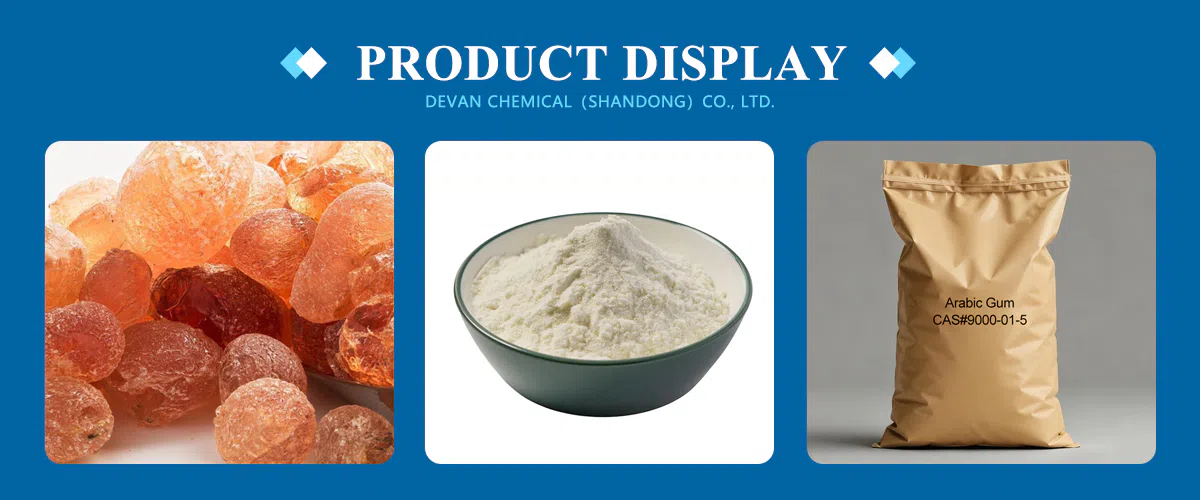
The product is commercially supplied in multiple forms, including yellow to pale brown translucent chunks, as well as off-white to light yellow particles and fine powder. In general, products with lighter coloration deliver higher overall quality. Freshly processed Arabic Gum presents a smooth surface and fully transparent internal structure, with neutral odor and taste. It exhibits excellent water solubility, capable of dissolving in large quantities in both hot and cold water to generate clear, high-viscosity aqueous solutions.
Leveraging its superior colloidal protection, stabilizing performance, thickening capacity and low digestibility, it is well-suited for the formulation of low-calorie food products. In confectionery manufacturing, it effectively inhibits sugar crystallization and over-thickening, promotes even fat distribution, and prevents the formation of oxidized oily surface layers. For dairy processing, it achieves powerful water-binding effects and sustains stable hydration status. When applied in bread and pastry production, it smooths product surfaces and adapts well to transparent glazes, sugar coatings and snack formulations. It enhances the stability of sugar coating layers while optimizing surface fluidity and adhesion. Furthermore, the substance can serve as a flavor carrier, emulsifying agent for beverages, and foam stabilizer for beer products.
Arabic Gum Chemical Properties
| density | 1.35 |
| FEMA | 2001 | ACACIA GUM (ACACIA SENEGAL (L.) WILLD.) |
| storage temp. | Sealed in dry,Room Temperature |
| solubility | water: soluble |
| form | fine powder |
| color | White to yellow-beige |
| Specific Gravity | 1.35-1.49 |
| Odor | ylsh.-wh. angular fragments, odorless |
| PH Range | 4.1 - 4.8 |
| Odor Type | Bland |
| Water Solubility | Water soluble. Aqueous solution is acidic to litmus. |
| Merck | 14,14 |
| Stability: | Stable. Incompatible with alcohols, oxidizing agents. |
| CAS DataBase Reference | 2593228 |
| EPA Substance Registry System | Gum arabic (9000-01-5) |
| Hazard Codes | Xi |
| Risk Statements | 36-36/37/38 |
| Safety Statements | 26-36/37/39-27 |
| WGK Germany | 2 |
| RTECS | CE5945000 |
| TSCA | Yes |
| HS Code | 13012000 |
| Hazardous Substances Data | 9000-01-5(Hazardous Substances Data) |
| Toxicity | LD50 orl-rat: >16 g/kg FDRLI* 124,-,76 |

Product Application of Arabic Gum CAS#9000-01-5
Arabic Gum serves as a versatile thickening, stabilizing and emulsifying additive with extensive utilization across the food manufacturing industry. In accordance with China’s GB2760-86 food additive standards, it is approved for use as a thickener in beverages, chocolate, ice cream and jam, with a regulated maximum dosage ranging from 0.5 to 5.0 g/kg.
In line with the 1984 FAO/WHO regulatory guidelines, this ingredient features clear permissible application scopes and dosage limitations for diversified food categories. It is allowed at a dosage of 10 g/kg for canned green beans, yellow beans, sweet corn, mushrooms, asparagus, green peas and similar canned produce, whether applied independently or compounded with other thickeners, particularly for oil and butter-containing food systems. For processed cheese items, the permitted dosage is 8 g/kg for single use or combined application with alternative thickening agents. In pickled food production, the allowable dosage reaches 500 g/kg when used alone or blended with co-solvents and dispersants. The standardized dosage for canned carrot products is set at 10 g/kg. For cream products, the applicable limit is 5 g/kg, suitable for pasteurized whipped cream, UHT sterilized cream and conventional sterilized whipping cream with single or compound use of thickeners and modifiers. Cold beverage products permit a maximum dosage of 10 g/kg based on finished product weight, compatible with mixed formulations of emulsifiers, stabilizers and thickeners.
Apart from standardized food applications, Arabic Gum acts as an effective stabilizer for hard candies and gelatin-based gummy confectioneries. It also delivers anti-crystallization and surface polishing effects in various confectionery products, with professional filtration treatment required during practical industrial application.