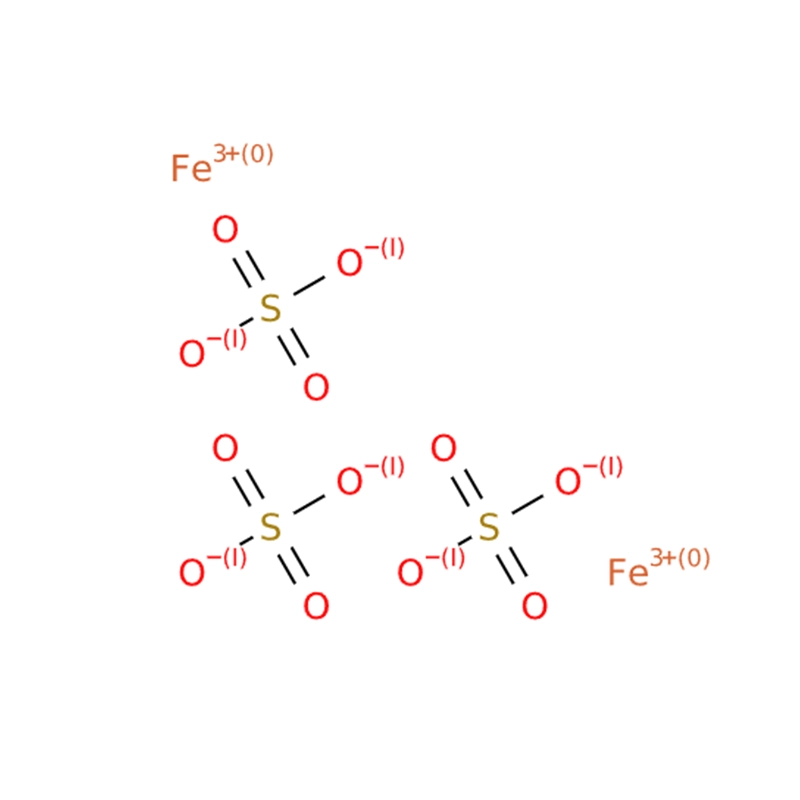
Product Description: Polyferric Sulfate CAS# 10028-22-5
Ferric sulfate, also termed iron(III) sulfate, is the ferric-valent salt of sulfuric acid. It is extensively adopted as a mordant in dyeing operations and acts as a coagulant for industrial wastewater treatment. Within the medical sector, it serves as an astringent and haemostatic agent to curb or halt bleeding. It is also regarded as an efficient pulpotomy medicament for primary teeth, holding potential to substitute formocresol.Furthermore, ferric sulfate finds application in pigment manufacturing and pickling baths for aluminium and steel. Commercially, it is generally synthesized by reacting ferrous sulfate with sulfuric acid in the presence of an oxidizing agent such as nitric acid.
Ferric sulfate Chemical Properties
Melting point | 480°C |
Boiling point | 101-118 °C |
density | 3.097 |
vapor pressure | 0Pa at 20℃ |
storage temp. | Keep in dark place,Inert atmosphere,Room temperature |
solubility | slightly soluble in ethanol; insoluble in acetone |
form | Powder |
color | Yellow-gray |
Water Solubility | Soluble in water. Sparingly soluble in alcohol. Almost insoluble in acetone and ethyl acetate. Insoluble in sulfuric acid and ammonia. |
Sensitive | Hygroscopic |
Merck | 144032 |
Exposure limits | ACGIH: TWA 1 mg/m3 |
NIOSH: TWA 1 mg/m3 | |
LogP | -1.031 (est) |
CAS DataBase Reference | 10028-22-5(CAS DataBase Reference) |
NIST Chemistry Reference | Ferric sulfate(10028-22-5) |
EPA Substance Registry System | Ferric sulfate (10028-22-5) |
Safety Information
Hazard Codes | Xn |
Risk Statements | 22-36/37 |
Safety Statements | 26 |
RIDADR | UN 9121 |
WGK Germany | 3 |
RTECS | NO8520000 |
TSCA | Yes |
HS Code | 2833298080 |
Hazardous Substances Data | 10028-22-5(Hazardous Substances Data) |
Product Applications
It is extensively employed for turbidity reduction of diverse industrial water sources and wastewater generated from mining, printing-dyeing, papermaking, food processing and leather industries. It delivers outstanding purification efficiency for lightly contaminated water, algae-laden water, as well as low-temperature and low-turbidity raw water. Especially remarkable treatment performance can be achieved for high-turbidity raw water.