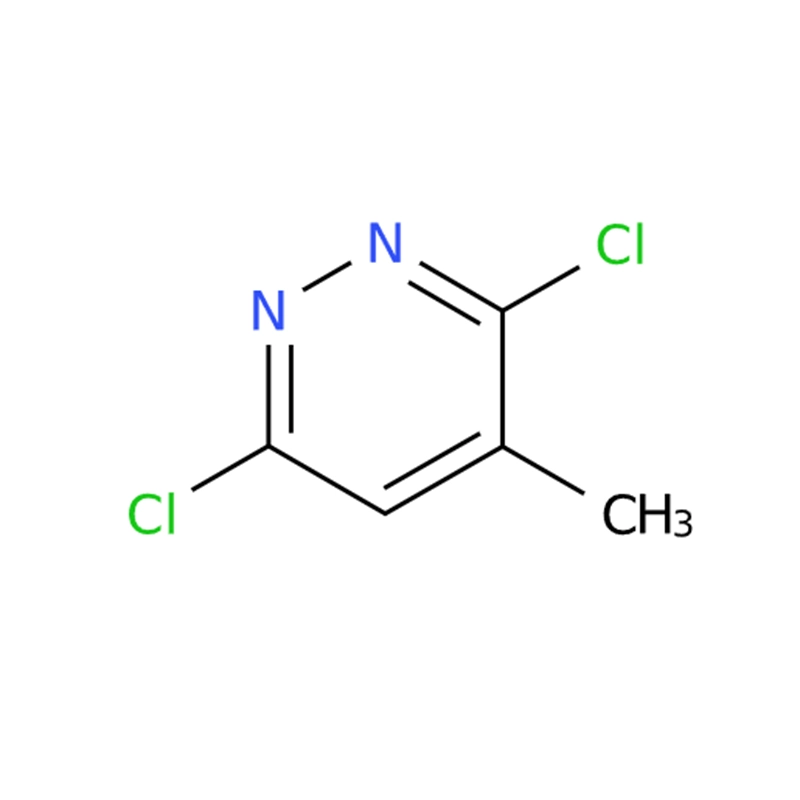
Product Description of 3,6-Dichloro-4-methylpyridazine CAS#19064-64-3
3,6-Dichloro-4-methylpyridazine is a chlorine-substituted pyridazine heterocyclic compound, possessing the molecular formula C₅H₄Cl₂N₂ and a molecular weight of 163.00. This substance usually appears as an off-white to light-brown crystalline solid under ambient conditions.
The two reactive chlorine atoms on the pyridazine ring are easily substituted through nucleophilic reactions, delivering favorable synthetic versatility. It has low water solubility and dissolves readily in common anhydrous organic solvents. The product can be supplied with high purity above 97%, showing good solid stability under dry and sealed conditions.

3,6-Dichloro-4-methylpyridazine Chemical Properties
| Melting point | 86-88 °C (lit.) |
| Boiling point | 149-151 °C/21 mmHg (lit.) |
| density | 1.5462 (rough estimate) |
| refractive index | 1.6300 (estimate) |
| Fp | 149-151°C/21mm |
| storage temp. | Keep in dark place,Sealed in dry,Room Temperature |
| solubility | Methanol[soluble in] |
| solubility | soluble in Methanol |
| form | Crystalline Powder |
| pka | -0.56±0.10(Predicted) |
| color | Off-white to light-brown |
| BRN | 119573 |
| InChIKey | ROYHWGZNGMXQEU-UHFFFAOYSA-N |
| CAS DataBase Reference | 19064-64-3(CAS DataBase Reference) |
| NIST Chemistry Reference | Pyridazine, 3,6-dichloro-4-methyl-(19064-64-3) |
| Hazard Codes | Xi,Xn |
| Risk Statements | 36/37/38-20/21/22 |
| Safety Statements | 26-37/39-36/37/39-22 |
| WGK Germany | 3 |
| HazardClass | IRRITANT |
| HS Code | 29339980 |

Product Application of 3,6-Dichloro-4-methylpyridazine CAS#19064-64-3
3,6-Dichloro-4-methylpyridazine is a versatile pyridazine-type heterocyclic intermediate widely used in pharmaceutical and agro-chemical synthetic routes. The two chlorine atoms on the ring are active leaving groups for nucleophilic substitution, enabling facile structural modification to build imidazopyridazine and other nitrogen-containing bioactive scaffolds. It is frequently adopted in early-stage drug discovery for developing kinase inhibitors, anti-inflammatory and central-nervous-system related candidate molecules.
Apart from pharmaceutical research, this compound also serves as a valuable starting material for synthesizing crop-protection agents and fine heterocyclic derivatives in custom organic synthesis projects.