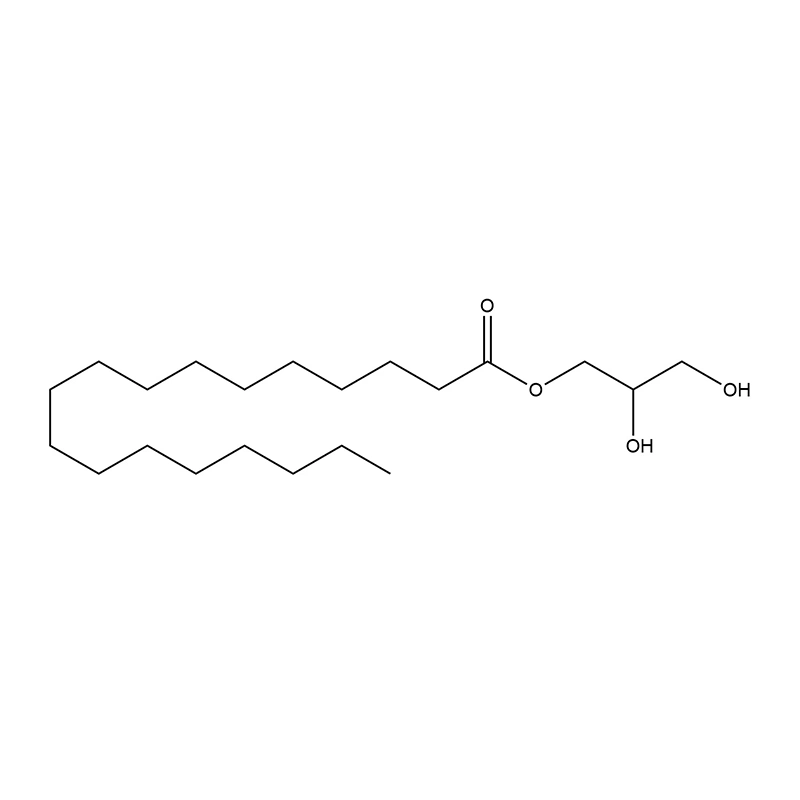
Products Description of Glyceryl monostearate CAS#31566-31-1
Glyceryl monostearate, also known as GMS, with molecular formula C₂₁H₄₂O₄ and molecular weight of 358.56, is a nonionic monoglyceride formed from glycerol and stearic acid. It appears as white or off-white flaky or waxy powder, nearly odourless. It is insoluble in cold water and can form stable dispersion after vigorous stirring with hot water. It dissolves in ethanol, chloroform and hot organic solvents. It features good emulsifying, stabilizing and lubricating properties. This multi-functional additive is widely used in food, cosmetics, pharmaceutical excipient and plastic processing industries.
Glyceryl Monostearate Chemical Properties
| Melting point | 78-81 °C |
| Boiling point | 410.96°C (rough estimate) |
| density | 0.97 |
| refractive index | 1.4400 (estimate) |
| storage temp. | Sealed in dry,Store in freezer, under -20°C |
| solubility | Soluble in hot ethanol, ether, chloroform, hot acetone, mineral oil, and fixed oils. Practically insoluble in water, but may be dispersed in water with the aid of a small amount of soap or other surfactant. |
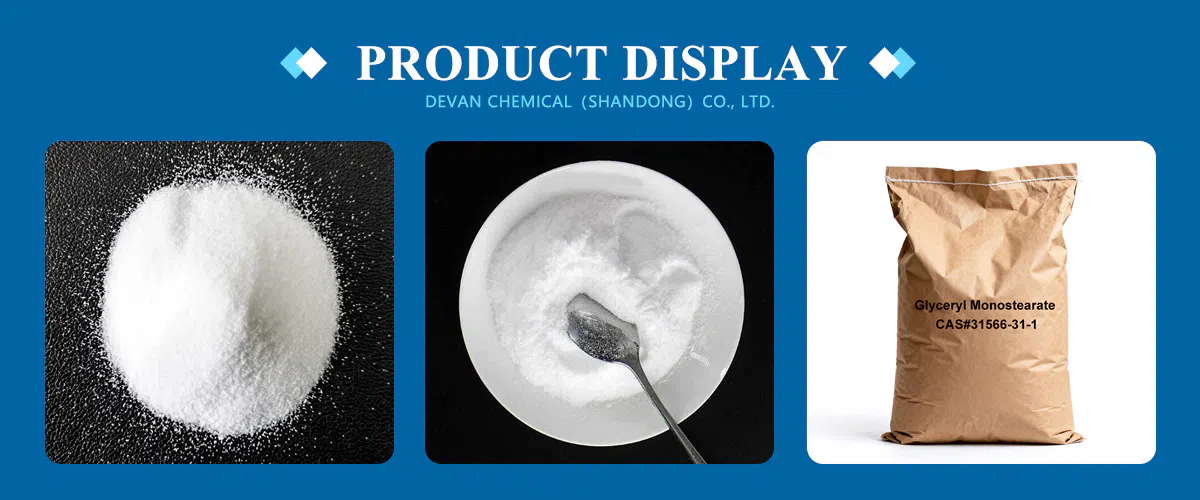
| form | wax-like solid or powder |
| color | Pure-white or cream-colored |
| Odor | faint odor |
| Water Solubility | Soluble in hot organic solvents.Soluble in hot water. Slightly soluble in ethanol. Insoluble in aliphatic solvents. |
| Merck | 144489 |
| Exposure limits | ACGIH: TWA 10 mg/m3; TWA 3 mg/m3 |
| InChI | InChI=1S/C21H42O4/c1-2-3-4-5-6-7-8-9-10-11-12-13-14-15-16-17-21(24)25-19-20(23)18-22/h20,22-23H,2-19H2,1H3 |
| InChIKey | VBICKXHEKHSIBG-UHFFFAOYSA-N |
| SMILES | C(OCC(CO)O)(=O)CCCCCCCCCCCCCCCCC |
| CAS DataBase Reference | 31566-31-1(CAS DataBase Reference) |
| EPA Substance Registry System | Glyceryl monostearate (31566-31-1) |
| WGK Germany | 1 |
| TSCA | Yes |
| HS Code | 2918199890 |
| Toxicity | LD50 ipr-mus: 200 mg/kg NTIS** AD277-689 |

Product Application of Glyceryl Monostearate CAS#31566-31-1
Glyceryl monostearate is a high-performance emulsifier featuring wide-ranging applicability. As a food additive, it finds its most frequent use in bread, biscuits and baked pastries, alongside the manufacturing of cream, butter and ice cream. It inhibits starch retrogradation, improves texture and extends shelf life of baked goods.
Within the pharmaceutical sector, it acts as an excipient for neutral ointment preparations, helping adjust viscosity and stabilize ointment matrix. For personal care formulations, it is incorporated into facial creams, skin balms and carrier oil products, delivering moisturizing and thickening effects.
Moreover, it serves as a solvent for oils and waxes, a protective agent for hygroscopic powders, and an opacifier. In plastic and polymer industries, it works as internal lubricant and antistatic additive for plastic resin processing, improving product surface smoothness and processing fluidity. It is suitable for food, cosmetic, pharmaceutical and plastic manufacturing systems with multiple available grades to meet diverse formulation requirements.