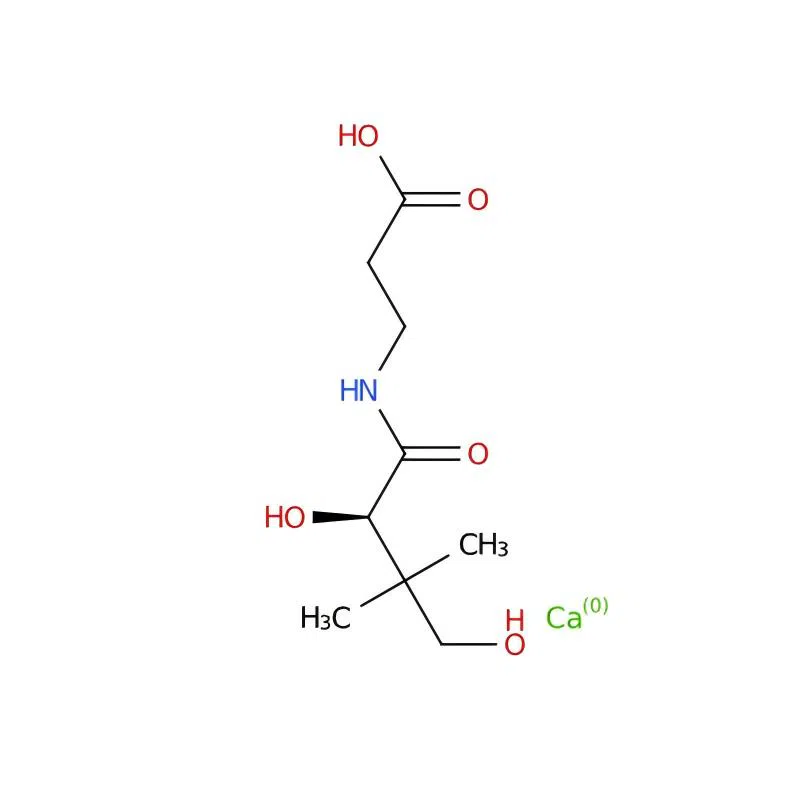
Product Description of Calcium D-Pantothenate CAS#137-08-6
Often referred to as calcium pantothenate, this substance represents the natural-existing variant of pantothenic acid, one indispensable vitamin found in many kinds of food sources. The ingredient has obtained GRAS (Generally Recognized As Safe) certification in American and European markets. Under the requirements set forth by the US-FDA, every 100-calorie portion of ready-to-use infant formula is required to carry no less than 300 micrograms of calcium pantothenate.
Calcium D-Pantothenate Chemical Properties
| Melting point | 190 °C |
| alpha | 26.5 º (c=5, in water) |
| refractive index | 27 ° (C=5, H2O) |
| Fp | 145 °C |
| storage temp. | 2-8°C |
| solubility | H2O: 50 mg/mL at 25 °C, clear, nearly colorless |
| form | Powder |
| color | White or almost white |
| PH | 6.8-7.2 (25℃, 50mg/mL in H2O) |
| Odor | Odorless |
| biological source | synthetic (organic) |
| Optical Rotation | [α]20/D +27±2°, c = 5% in H2O |
| Water Solubility | Soluble in water. |
| Sensitive | Hygroscopic |
| Merck | 147015 |
| BRN | 3769272 |
| Stability: | Stable, but may be moisture or air sensitive. Incompatible with strong acids, strong bases. |
| InChIKey | FAPWYRCQGJNNSJ-UBKPKTQASA-L |
| LogP | -0.849 (est) |
| CAS DataBase Reference | 137-08-6(CAS DataBase Reference) |
| EPA Substance Registry System | Calcium pantothenate (137-08-6) |
| Hazard Codes | Xn |
| Risk Statements | 20/21/22-37/38-41-48 |
| Safety Statements | 24/25-45-36/37/39-26-22 |
| WGK Germany | 1 |
| RTECS | RU4375000 |
| F | 46091 |
| TSCA | Yes |
| HS Code | 29362400 |

Product Application of Calcium D-Pantothenate CAS#137-08-6
This compound can be employed for biochemical-related experiments and added as nutritive ingredients inside tissue-culture culture mediums. From the medical perspective, it helps tackle vitamin-B shortage, peripheral neuritis as well as stomach cramps occurring after surgical operations.
Apart from that, it works as a food-grade nutrition enhancer. The recommended addition amount reaches 15-28 mg per kilogram for infant-targeted food, while the dosing range for drinks stays between 2-4 mg/kg.