
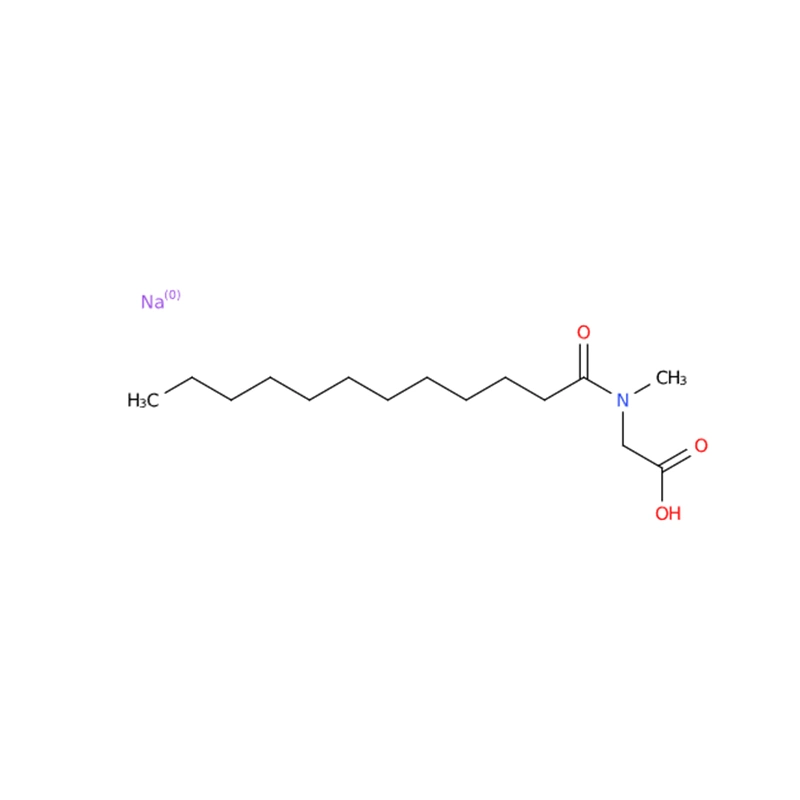
Products Description of Sodium Lauroyl Sarcosinate CAS#137-16-6
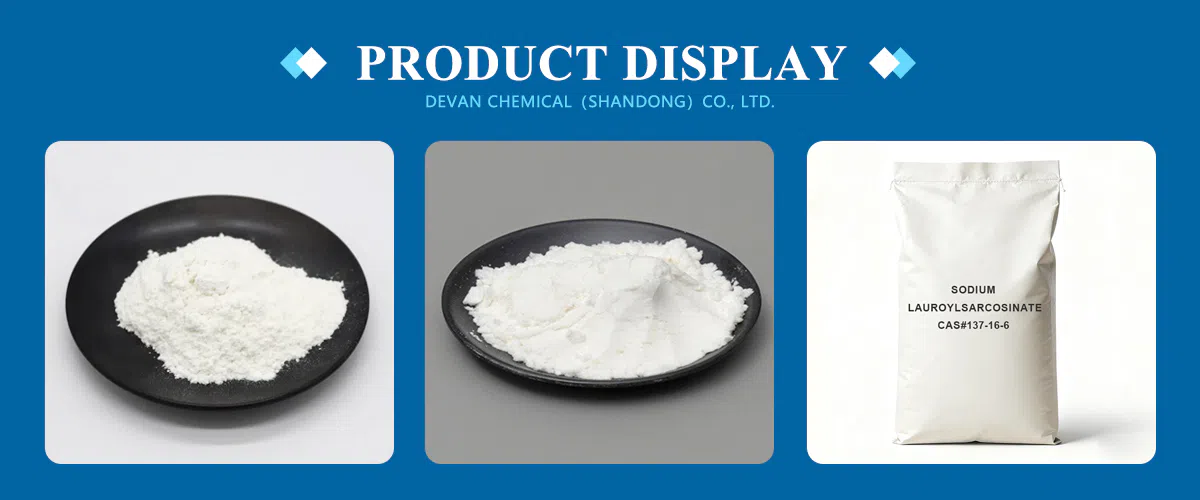
Sodium lauroyl sarcosinate is an amino acid based anionic surfactant with a molecular formula of C15H28NNaO3 and a molecular weight of 293.38. It is derived from the condensation of lauric acid with sarcosine, followed by neutralization into its sodium salt form. The product is available as a white to off white powder, or as a clear light yellow aqueous solution with an active content of about 30%, and it dissolves readily in water to form a mild foaming system.
Known for its excellent foaming, emulsifying and wetting properties, it provides gentle cleansing with low skin and eye irritation, good biodegradability and stable performance in hard water.
Sodium Lauroyl Sarcosinate Chemical Properties
| Melting point | 46 °C |
| density | 1.033 g/mL at 20 °C |
| vapor pressure | 0.02 hPa (20 °C) |
| RTECS | MC0598960 |
| Fp | 267℃ |
| storage temp. | room temp |
| solubility | H2O: 1 M at 20 °C, clear, colorless |
| form | Powder |
| color | White to off-white |
| Specific Gravity | 1.03 (20/4℃) |
| PH | 7.0-9.0 (25℃, 1M in H2O) |
| Odor | Non-irritating |
| Water Solubility | Soluble in water (293 g/L). |
| Sensitive | Hygroscopic |
| λmax | λ: 260 nm Amax: 0.2 |
| λ: 280 nm Amax: 0.06 | |
| Merck | 144368 |
| BRN | 5322974 |
| Stability: | Stable. Incompatible with strong oxidizing agents. |
| LogP | 0.37 |
| CAS DataBase Reference | 137-16-6(CAS DataBase Reference) |
| EPA Substance Registry System | Sodium N-lauroylsarcosinate (137-16-6) |
| Hazard Codes | Xi,T |
| Risk Statements | 36/37/38-41-38-23 |
| Safety Statements | 22-24/25-36/37/39-27-26-45-38-37/39 |
| RIDADR | UN 2811 6.1 / PGII |
| WGK Germany | 3 |
| F | 46091 |
| TSCA | Yes |
| HazardClass | 6.1 |
| PackingGroup | II |
| HS Code | 34021190 |
| Toxicity | LD50 orally in Rabbit: 2888 mg/kg |
Product Application of Sodium Lauroyl Sarcosinate CAS#137-16-6
Sodium lauroyl sarcosinate is a mild, amino acid derived surfactant widely used in personal care, oral care and industrial applications. In toothpaste formulations, it acts as an effective foaming and cleansing agent that enhances the removal of plaque and food debris while providing a pleasant foam texture, and it also exhibits synergistic antibacterial activity when combined with other oral care actives. In shampoos, facial cleansers, shower gels and shaving products, it delivers gentle yet efficient cleaning with low irritation to skin and eyes, making it especially suitable for sensitive skin and baby care formulations.
In industrial fields, it is applied as a corrosion inhibitor in metalworking and metal cleaning fluids, as well as in household and institutional cleaning products. Owing to its excellent hard water tolerance and biodegradability, it performs reliably in various water conditions and meets the growing demand for eco-friendly ingredients.